The Secret Behind the Name ‘Nepal’: Why a Sage, a Cow, and a Bundle of Wool hold the Key
Have you ever wondered why our country is called Nepal? While we use the name every day, its origin is a fascinating puzzle of ancient myths, lost languages, and sacred legends. From a mysterious sage who once lived at the confluence of the Bagmati to the cold plateaus where wool was traded, the name “Nepal” is more than just a label; it is a 2,500-year-old story.
The Legend of the “Silent Protector” (Ne Muni):

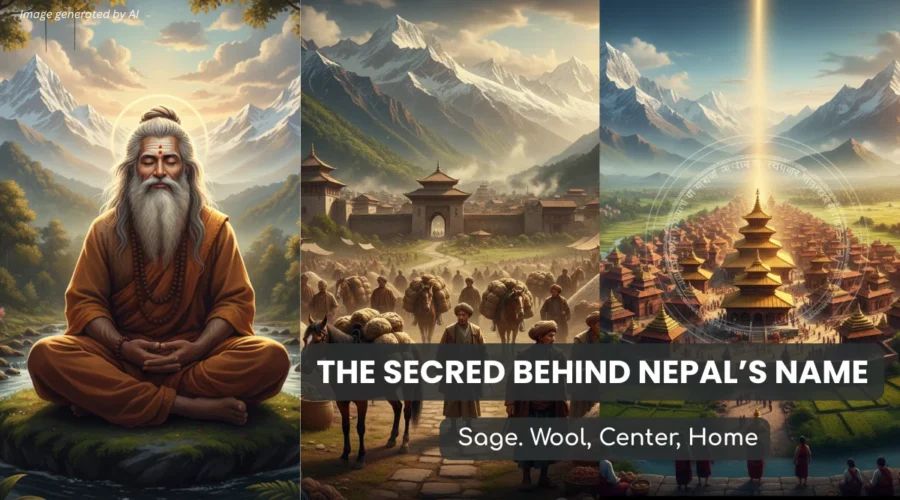
The most famous story takes us back to a time before kings. A Hindu sage named Ne (or Nemuni) is said to have performed deep penance at the junction of the Bagmati and Bishnumati rivers.
According to the Pashupati Purana, this sage was not just a meditator but a protector. The word ‘Pala’ in Sanskrit/Pali means “to protect” or “to nurture.” Thus, the land protected by the sage Ne became Ne-pal. Legend says he even selected the first king of the Gopal (Cowherd) dynasty, Bhuktaman, to rule the valley.
The “Home of Wool” (Tibetan Theory):

Before it was a unified nation, the Kathmandu Valley was a massive hub for Himalayan trade. In Tibetan, ‘Ne’ means “home” and ‘Pal’ means “wool.”
Because the valley was the primary marketplace where traders brought wool from the high mountains, it was nicknamed the “Home of Wool.” For a merchant traveling through the freezing passes, “Nepal” was the warm destination at the end of the trail.
The “Central Country” (Newari Etymology):

For the indigenous Newar community of the valley, the name has a geographical soul. In the Newari language, ‘Ne’ means “center” and ‘Pa’ means “country.”
Located between the high peaks of Tibet and the hot plains of India, the valley was literally the “Middle Country.” Over centuries, the local term ‘Nepa’ evolved into the ‘Nepal’ we recognize globally today.
Did You Know?
The first written mention of “Nepal” wasn’t in a history book, but in the Arthashastra by Kautilya (3rd Century BCE), where he praised the quality of blankets imported from the “Nepala” region!

A “Sacred Cave” or a “Plain Land”:
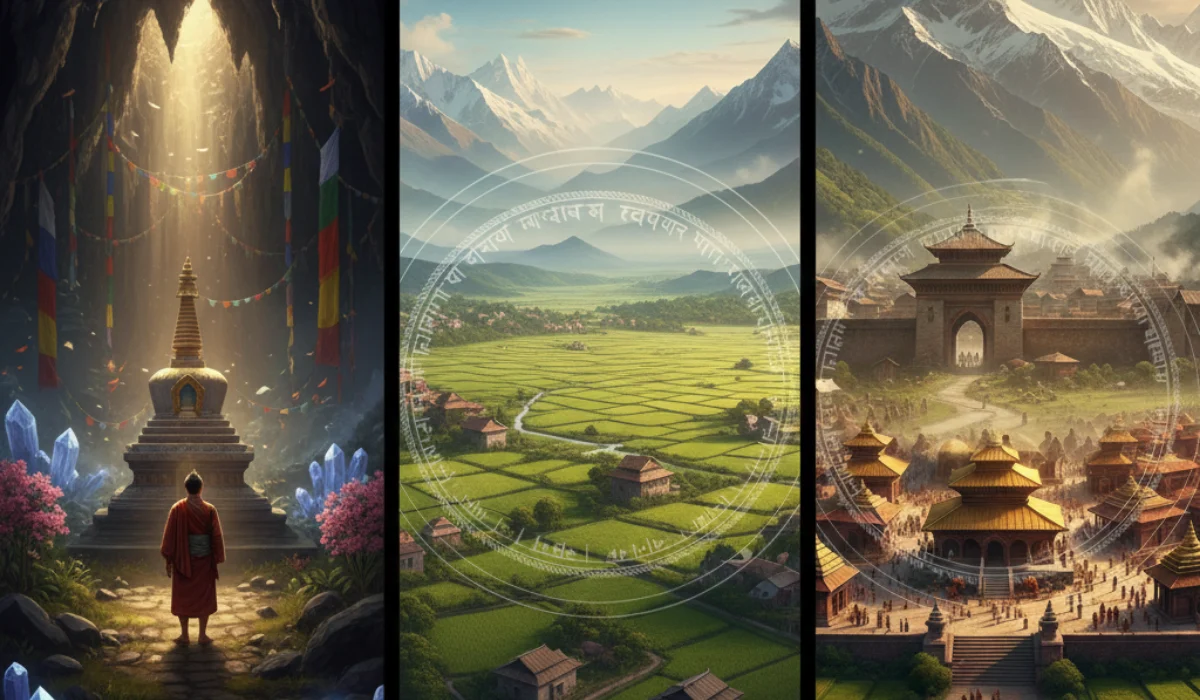
The beauty of our name is that every ethnic group sees a different truth in it:
- In Lepcha: ‘Ne’ means holy and ‘Pal’ means cave. To them, Nepal is a “Holy Cave.”
- In Limbu: ‘Ne’ refers to a “Plain Land,” perfectly describing the flat expanse of the Kathmandu Valley sitting amidst the rugged hills.
Why This Matters Today:
Whether you believe it was named after a saint or a trade product, the name “Nepal” has remained uninterrupted for millennia. It survived empires, unification, and the shift from a Kingdom to a Republic.
What do you believe?
Is Nepal the land of the protector, or the center of the world?